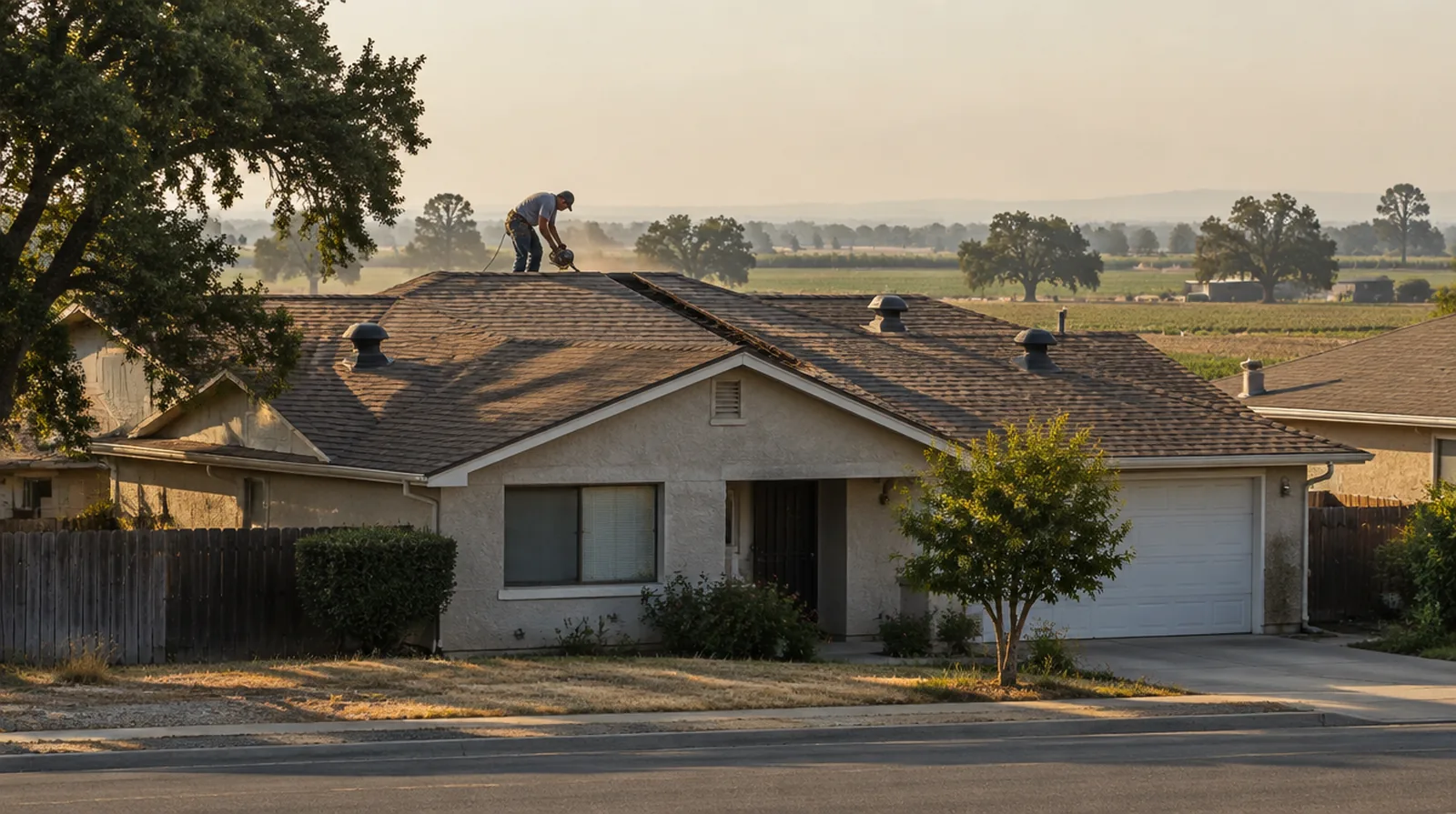
Why roof ventilation matters so much in Tulare
Think of the attic as a box sitting in the sun. With no openings, the heat has nowhere to go, and on a long July afternoon the air in there can climb far above the temperature outside. Every bit of that heat presses against the underside of the roof deck, drying the asphalt in your shingles from below and warming the ceiling of every room under it. Then winter brings the opposite issue: weeks of damp fog, with humid household air drifting up through ceiling gaps and condensing on cold plywood overnight.
Ventilation solves both problems the same way, by giving air a steady path through the attic. Fresh air comes in low at the eaves and leaves high at the ridge, carrying heat out in summer and moisture out in winter.
Clues that the attic is not breathing
- The attic hatch feels hot to the touch on summer evenings
- The sunny side of the roof is aging noticeably faster
- Dark or stained plywood on the underside of the deck
- Nail tips in the attic that are rusty or drip in winter
- Bedrooms that will not cool down until well after midnight
Our roof ventilation process
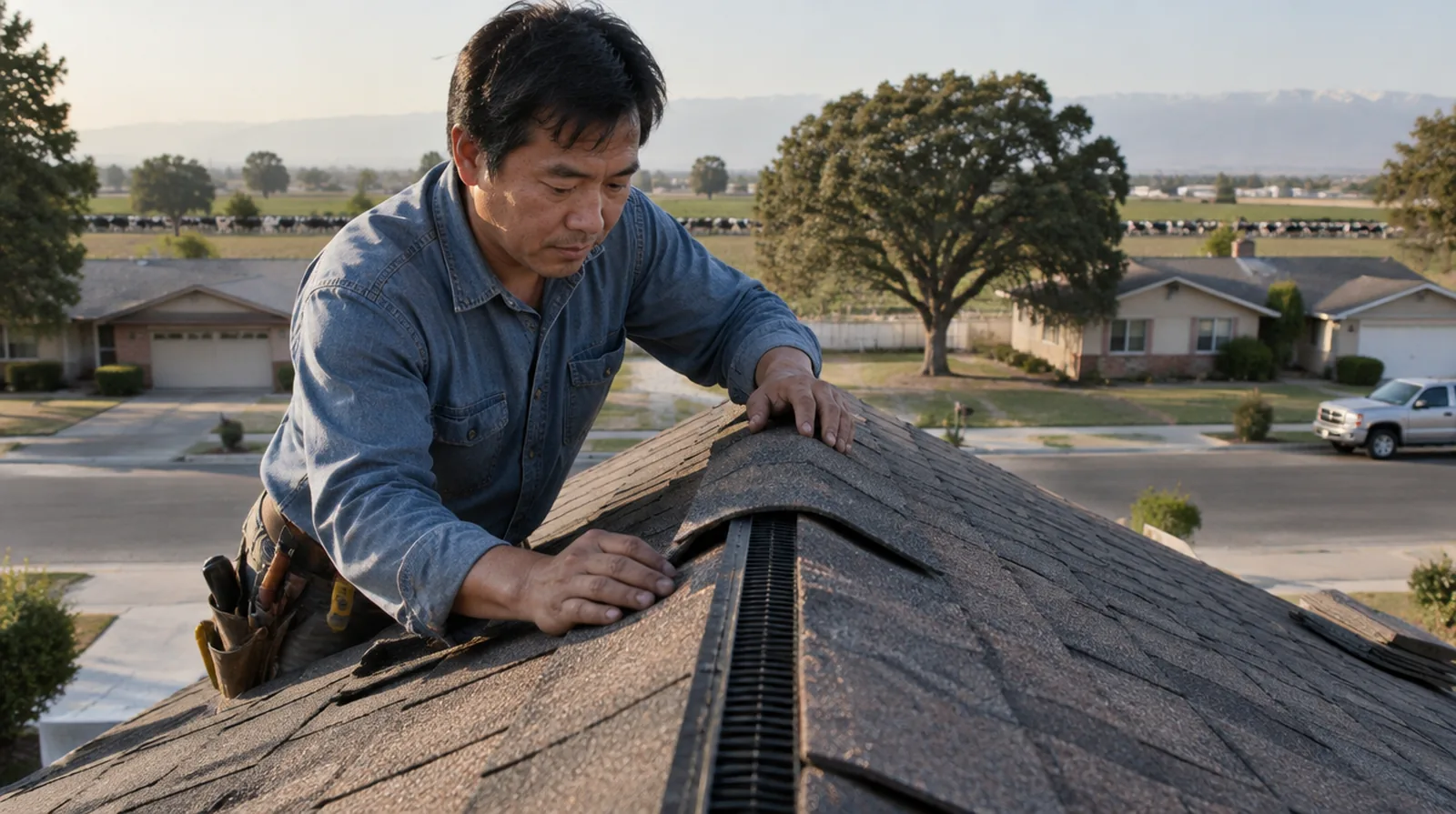
It begins in the attic with a flashlight. We look at the eaves to see whether soffit vents exist and whether insulation has buried them. We look up to see what exhaust is there today, whether that is a few small box vents, a turbine or gable louvers. From that, we work out how much intake and exhaust the attic needs to move air evenly.
The fixes are straightforward. At the eaves, we open or add soffit vents and set baffles so insulation cannot slump back over them. At the top, a continuous ridge vent is usually the cleanest exhaust on a shingle roof and is easiest to cut in during asphalt shingle replacement. Tile roofs get vents designed for their profile. Remember that airflow will not stop water coming in; leaks are a separate job for our leak repair team.
One clear airflow path
More vents are not always better. If exhaust outpaces intake, the attic pulls cooled air up from the house. If a ridge vent and a gable louver are both open, air can sneak in one and out the other, leaving the lower attic stagnant. We plan the system so air enters at the bottom and exits at the top, nothing in between.
Homes with solar
Panels cover a lot of Tulare roofs. They limit where exhaust can go, so we map the array and place vents in open areas near the ridge. If solar is in your plans, mention it before we design the layout.
Small attic spaces
Additions, garages and bonus rooms often have their own small attic, cut off from the main one. Each needs its own intake and exhaust, or it becomes a hot pocket that ages that part of the roof early.
When to schedule ventilation work
The easiest moment is during a re-roof, when the ridge is open and the deck is bare. Still, most improvements can be done any time on a roof in good condition, and doing them before summer lets you feel the difference right away.
Roof ventilation FAQs
Can ventilation be added to my current roof?
Yes. Soffit vents, baffles and roof vents can all be installed without a full re-roof.
Would an attic fan be a good idea?
Not always. Without enough intake, a fan can pull air from the living space. Passive airflow is usually the first step.
Will my power bill go down?
A cooler attic helps, though insulation and duct condition play a big role too.
Should my gable vents stay open?
With a ridge vent, gable vents can short-circuit airflow. We look at your attic before advising.
Want the attic to breathe?
Call (559) 461-9887 for a roof ventilation look and estimate.